



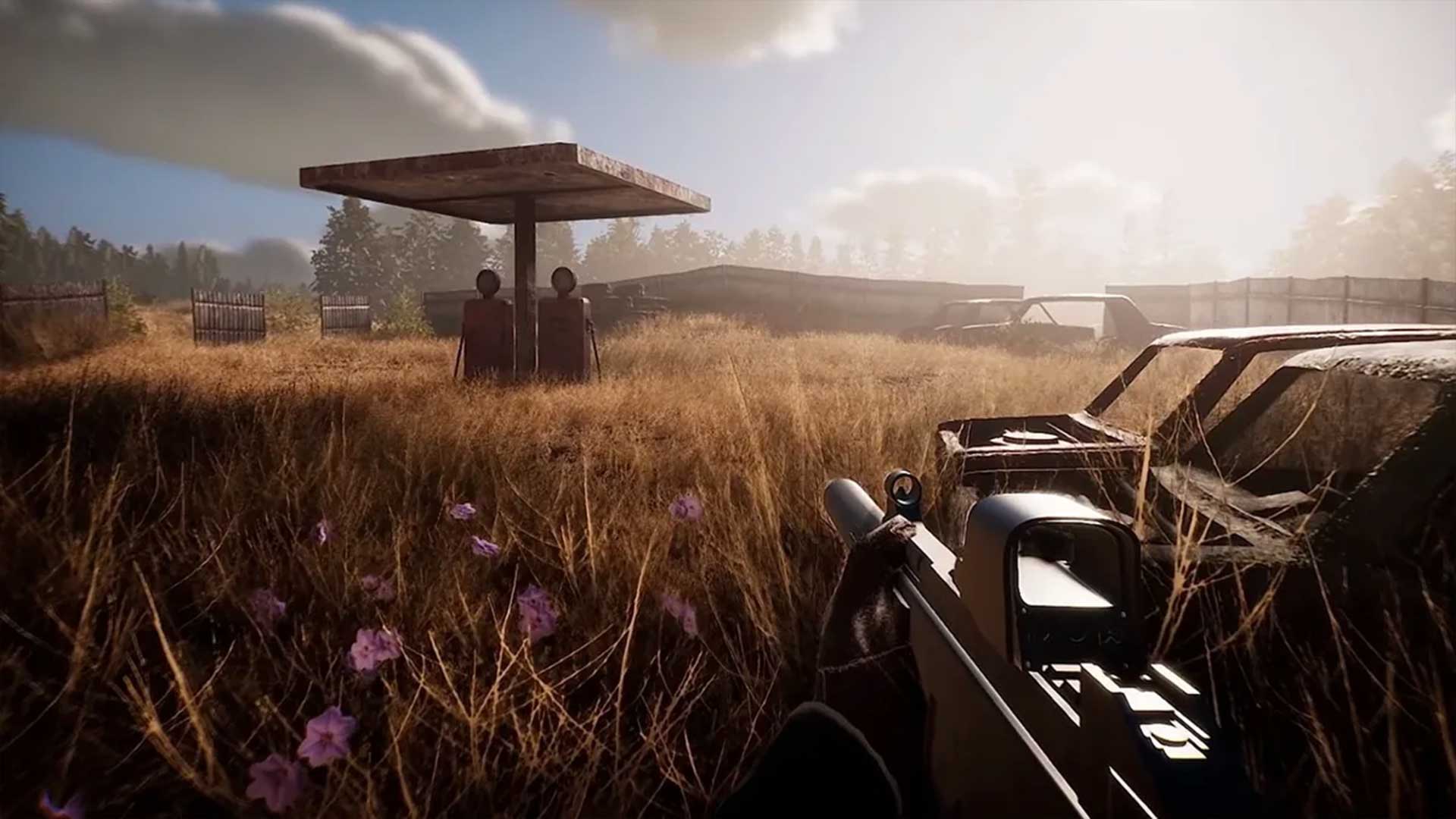


ORMOD: Directive initially looks like a classic hardcore survival game in the vein of DayZ. But behind its post-apocalyptic world lies much more: character progression, extensive base building, factories, automation, and highly customizable servers are all supposed to come together over time. At Gamescom 2026, I got to play a compact demo and talk to the developers about their plans for the game.
In the full game, you are supposed to start with almost nothing, gather resources, craft tools, and gradually build your first base. However, the Gamescom demo did not show that regular opening. Instead, I started with equipment already available and immediately found weapons, ammunition, and other items so I could test as many systems as possible in a short amount of time.
The Gamescom Demo Was Mainly a Showcase of What the Game Will Offer
The demo was essentially a short tour through some of ORMOD’s major features. After finding the first weapons, I quickly encountered robotic enemies, followed by a weapon workbench with different attachments, a small automated production setup, and a partially constructed base. There was even a much larger robot roaming the area, although it did not attack during the demo.
According to the developers, that will be different in the actual game. The larger machines are meant to become real threats, while different Mechanoids will have specific weak points that you can target in combat. So instead of zombies, ORMOD pits you against machines, and they are supposed to become especially dangerous at night, actively hunting players after dark.
A World That Can Essentially Go On Forever
ORMOD’s world is procedurally generated and can theoretically be endless. That generation is not limited to terrain either. Roads, buildings, towns, and important landmarks are also generated as part of each world. If an endless map sounds like too much, server owners will also be able to limit the world size.
The world is also designed to be highly persistent. Items physically exist in the environment and remain exactly where players leave them. That means you might come across someone else’s abandoned belongings or take items from another player’s base, while persistent servers are also supposed to keep evolving even when you are offline.
You can play solo, in co-op, or on larger community servers with PvE, PvP, Hardcore, and Creative modes. According to the developers, servers supporting thousands of players are planned in the long term. They also told me at Gamescom that private servers are expected to offer more than 400 customization options, covering things like resources, enemies, base building, automation, and PvP rules.
Base Building Comes With an Unusual Bird’s-Eye View
You can build a base almost anywhere and expand its build area later on. What I found especially interesting was the building mode itself. Instead of placing everything exclusively from your normal perspective, the camera switches to a bird’s-eye view where you can place blueprints for new structures. You then have to bring in the required resources to actually complete them.
However, the free camera is not meant to give you an advantage in PvP. While you are in building mode, other players and enemies are hidden from your view. At the same time, your own character remains fully visible to everyone else and can still be attacked, so planning your next factory in the middle of an open field would probably be a very bad idea.
From Basic Survivor to Automated Factory Owner
Activities such as gathering resources, chopping down trees, and crafting grant experience points and help you level up. A skill tree then allows you to unlock different improvements, such as collecting resources more efficiently or becoming stronger in combat. During the short demo, however, I only saw a small part of that system.
The automation stood out much more. Inside a barn, there was a small production setup with conveyor belts and machinery that already gave a good impression of where the system is supposed to go. According to House 16 Software, every resource in the game is eventually meant to be automatable, while larger factories will be able to manufacture weapons, supplies, and other equipment.
That pushes ORMOD well beyond what many traditional survival games offer. The small base you build early on can eventually turn into a full industrial operation. That progression from scavenging survivor to the owner of an automated factory is easily one of the most interesting ideas behind the game.
Survival Still Matters
Despite all the factories, ORMOD is not supposed to turn into a relaxed building game. In addition to hunger and thirst, you will have to deal with sickness, injuries, temperature, medical conditions, farming, and cooking. The weapon system is also intended to be relatively detailed, with attachments, leaning, different reload speeds, as well as penetration and armor simulation.
There are also plans for dynamic events outside your base, including airdrops, helicopter crash sites, and global PvP events. On top of that, you will be able to repair and use vehicles such as cars and helicopters, with manual gears and more realistic driving and flight handling planned as well.
Quests, player trading, and a dynamic item-based economy are also part of the plan. Combined with automated factories, that could eventually lead to an interesting player-driven economy where not everyone necessarily has to produce everything themselves. How deep that system will go is something I could not judge from the Gamescom demo.
My First Impression of ORMOD: Directive
ORMOD: Directive left me with a pretty positive first impression. The DayZ comparison is easy to make because of the survival focus, open world, and persistent servers, but once character progression, extensive base building, and full automation enter the picture, the game starts moving in a very different direction.
The Gamescom demo was clearly designed as a showcase for the different systems and did not really demonstrate what a normal start or long-term progression will feel like. That is why I would not judge yet whether all of these mechanics will ultimately fit together smoothly.
The potential is definitely there, though. If House 16 Software manages to connect these systems in a meaningful way, ORMOD: Directive could become a rather unusual mix of hardcore survival and automated sandbox gameplay that offers far more than simply “DayZ with robots.”
0 comments
No comments yet. Start the discussion.
Create an account to comment
Sign in or create a free Guided account to join the discussion.